Tuesday, October 9, 2012
Report on September 16 Events
Will it rain – or be cold and windy? Are there seats enough out on the terrace at the Meeting House? Will anybody come? Will there be enough punch and cookies – or way too much? Where did I put the notes for the speech I plan to make, thanking those that let us photograph their WP Outhouses? Where’s my camera?
So ran my thoughts as Sunday afternoon, September 16 approached. The second half of a “double event” at the Township Historical Society it marked the completion of a self-published booklet, Humble but Historic, The Surviving WPA Outhouses of Franklin Township produced by Faulkenberg Printing, Indianapolis. I planned to autograph copies of the book for the invited guests – and others who might purchase one. (The other event, at 1:30, was a Big Run Cemetery Tour by Dana Crapo who has researched the early years of the cemetery when, privately owned, it was known as the Smither burial ground. See next week’s “Remembrances.”)
As often happens, my worries were needless. The weather was perfect, and a good crowd favored us. My daughter Ann and her three girls handled the punch and cookies, with more cookies supplied by Society members. Granddaughter Molly took photos including the one below.
There was an additional attraction on the Society grounds. With thanks to Yolanda Hughes, one-time owner, and Kathy George of Bob Cook Realtors – and Tommy Grimes, who moved it to our lawn—our Society is the proud owner of an authentic WPA outhouse, to be restored, repainted and valued as an exhibit of The Great Depression Days.
Thursday, October 4, 2012
Remembrances: 1855 Township Map
Old maps are fascinating to study, and are an almost endless source of speculation when compared with an area familiar to a reader today. Fellow historian Dana Crapo recently found and purchased the useful topographical map of the part of Franklin Township on Shelbyville Road we were wondering about. I used it several weeks ago in writing about the elevation of Scott and Mary Verbarg’s home in Franklin Parke Estates. Their hilltop site was designated as 900 feet above sea level, perhaps the highest spot in Franklin Township.Another map that Dana recently purchased, and gave me copies of is an 1855 Franklin Township map, the earliest one I know of. I have had a copy of it for several years – Xeroxed myself at the Indiana State Library -- but Dana’s copies are sharp and bright, and show more clearly some early “roads” which were later abandoned. A portion of that map is shown above, with the land owner designated as Daniel Moore.
The Society’s Historic Treasures (1978) includes this information (in a longer biography) about Daniel Moore. “He was born in 1786 in Virginia . . .At age thirty he moved with his family to Kentucky. . . later they moved to Marion County, Indiana, locating on a farm nine miles southeast of Indianapolis. . . in what was then an unbroken wilderness, the family proceeded to make a home. The forest was cleared away and a fine farm developed . . . The Moore farm was in the family since 1835 when Daniel Moore received his land grant signed by Andrew Jackson. Their log cabin was built at Five Points and Stop 11 (although the roads were not so named at the time) where they owned additional land."
Our family’s six acres was not part of the Moore farm, but a parcel of the Nimrod Kemper farm to the south. Shelbyville Road cut through the corner of the Kemper farm as it did at another place the Moore farm. Our six acres includes a two acre field, and a wooded area which I was told was the woodlot for the Kemper farm across the road.When we first moved here I remember some “elderly “ ladies telling me they had picked wildflowers in our woods as children. Except for the field and a small area along Shelbyville Road, our land has never been farmed. We have three large ash trees, two beech trees, and an oak tree with a trunk 15 feet in circumference. Some large rocks in the yard are either remains of a glacier, or dug out of Kemper fields long ago.
Friday, September 28, 2012
Indiana trees
“A hundred years ago fully seven-eighths of the State of Indiana was covered with forests.” Since I’m quoting from a book (Indiana, a Guide to the Hoosier State, written in 1941), I had better make that “200 years ago”.
The early settlers were mostly farmers, hoping to make homes in which to raise and feed their families. They found their tracts of land covered with trees. Historians described the trees, growing so large and close together, that light could hardly reach the forest floor. Charles Deam in his Trees of Indiana (1931), reported 134 species, 124 native to Indiana, the other ten having been successfully introduced. Deam identified 17 species of oak, the black walnut and many species of maple tree. he also described “the beech, lovingly painted by Indiana artists for its mottled trunk and rich autumn colors, the massive sycamore, gleaming white along the banks of streams, and the majestic tulip tree, or yellow poplar, the State tree.”
But as beautiful as the trees were, the early settlers saw them not as adornment, but as something to be removed from the land, so that they could plant their crops. They spent much energy and time in clearing their farms. “Deadening” the trees was one method, removing the bark from an area surrounding the trunk, causing the tree to die. It was a slow process, but as the branches withered, light fell on the ground and made it possible to plow and plant underneath the tree.
“Log-rollings” were popular as community projects, where groups of men and women gathered. The men cut the trees down with their axes, cut and burned the underbrush, then chopped the trees into 10 to 20 foot lengths. These were piled up and burned. The women prepared a big meal to be enjoyed at the close of the day. Many of the best logs of oak, poplar, walnut and ash were left at the rollings to be split into rails for fences.
But some trees survived the land-clearing, perhaps by their location in a farmyard or by their size or beauty. One such tree stands along Shelbyville Road on a curve near Edgewood Avenue. It is, I believe, a kind of oak tree (a chestnut oak?) for an acorn was forming in the clump of leaves we picked up. The leaves are oval in shape, not lobed as are the leaves of many oaks. I once asked a man standing by his mailbox across the road from the tree if it had a special history was a landmark, an early campsite, a boundary. No, he said, not that he knew of. ‘‘It’s just a big ole tree,” he said. If anyone knows more than that, please let me know.
Wednesday, September 19, 2012
Shelbyville Road Farm History, part II
Today, we bring you one of Sylvia Henricks' "Remembrances." You can read more of Sylvia's columns weekly in The Franklin Township Informer, or in her book From The Ash Grove (available directly from the FTHS, and via the web site).
The hilltop farm home of Christian and Sophia Klasing on Shelbyville Road, which I wrote about in the September 5 “Remembrances,” is shown in another, later photo (at left), which appeared in the Township Historical Society’s publication The History of Franklin Township Area Old Houses (1982). By then, Christian and Sophia were deceased, the brick house abandoned, and the property sold. The new owners would develop the farm during the next several years into Franklin Parke Estates. The hilltop site now holds two houses, one of them the home of Scott and Mary Verbarg, who are interested in the history of their property.The hilltop remains. That there was a wide view from the hilltop was never in dispute. But just how high was the elevation? Historical Society member Dana Crapo solved the question, by going downtown to the State Office Building and -- in spite of parking difficulties, and confusion in locating the right office -- buying a topographical map of the area which includes that part of Shelbyville Road where the Klasing farm lay. The map, 22” by 27”, printed by the U.S. Department of the Interior, is a U.S. Geological Survey, covers “the Beech Grove quadrangle.”(Topography, 1966; Roads, 1998.)
The map does record the height of the hill on which the farm house stood, slightly north of Shelbyville Road, at 900 feet. My six acres next door to the Franklin Parke Estates, are shown with two tiny black squares (one the garage) close to Shelbyville Road, east and somewhat south of the hilltop as 870 feet. I was surprised at this, as I always thought we lived “down in a hollow.” The Society Meeting House is 843 feet.
Indiana, A Guide to the Hoosier State, (1941) states on p.7 “About two thirds of Indiana is prevailingly level or rolling, while a smaller portion, largely in the south, is hilly. The average altitude is 700 feet above sea level. The greatest height, 1,285 feet is in Randolph County, near the eastern border; the lowest point, 313 feet, is in Vanderburgh County on the Ohio River.
(To be continued in a future "Remembrances.")
Wednesday, August 29, 2012
Shelbyville Road Farm History, part I
Today, we bring you one of Sylvia Henricks' "Remembrances." You can read more of Sylvia's columns weekly in The Franklin Township Informer, or in her book From The Ash Grove (available directly from the FTHS, and via the web site).
“You can see three counties from the top of that hill,” I remember a neighbor telling me about a nearby farm. An elderly widowed farm-wife lived in the small brick house, surrounded by an assortment of aging barns and outbuildings. I live near the site, but well below the hill, and had taken a photo of the hilltop scene from the end of the lane on Shelbyville Road. It has been one of my favorite photographs.
Now, 30 years later, all is changed. The farm has been gone for a long time, and the fields around it turned into Franklin Parke Estates, with its streets winding across the one-time fields. The hilltop remains, but is now the site of two handsome homes.
The new owner of one of the houses, Scott Verbarg, having seen my photograph of “The Klasing Farm,” asked me if the Township Historical Society had any information on what is now his property. I said I’d see what I could find.
I have been able to find a few items of interest. In the Society’s publication Historic Treasures of Franklin Township (1978 ) is a paragraph on page72 by an unsigned contributor, “Klasing History.” “Christian Klasing and his wife, Sophie (Kirkoff), came to the U.S. from Germany as children near the middle of the 1800’s.
“They were married in Indianapolis and in 1884 bought their 140 acre farm located at 7245 Shelbyville Road, presently owned by Mr. and Mrs. Allen Cary. The farm was purchased for approximately $8000 from Fred (Butch) Miller who had cleared all except forty acres of the land and built all the buildings that now stand on the farm.
“William Klasing (92) is the only living survivor of five boys and three girls in the Christian Klasing family. William owns seventy acres of the land which his mother and father bought, located at 7448 E. Southport Road.” Property lines and acreage can be seen in Section 13 on the 1889 Franklin Township map, one of the Society’s publications.
(To be continued in a future "Remembrances")
Wednesday, August 22, 2012
Ice Cream Social at Meeting House
Today, we bring you one of Sylvia Henricks' "Remembrances." You can read more of Sylvia's columns weekly in The Franklin Township Informer, or in her book From The Ash Grove (available directly from the FTHS, and via the web site).
The Franklin Township Historical Society celebrated the cooler weather at its Open Hours on Sunday, August 19 with an Ice-cream Social on the grounds, and recognizing new members to the Society. The names of 27 new members and those renewing their first year memberships, were placed in an old-fashioned glass churn base, with a name to be drawn later in the afternoon. That person would receive one of the Society’s woven coverlets showing historic buildings in Franklin Township.
Twenty or so membes and guests enjoyed the frozen-yoghurt “ice-cream” with a variety of toppings, and cookies, served in the shade of the building by Program Chair, Diana Hipple and her committee. Other members and guests in the Meeting House looked at a genealogy chart for Sue Winton, including many generations, and several recent gifts to the Society. One of these was a large wooden wheel upon which the bell to the original New Bethel Baptist Church had been attached, the gift of Oren Schilling.
At the close of the afternoon the name of the lucky winner of the coverlet was drawn, new member Mary L. Lovell.
Those present were reminded of the Open Hours on Sunday, September 16, when Dana Crapo will give a Big Run Cemetery Tour. That afternoon will also include at its conclusion, a book signing session for the Societiy’s new publication, “Humble but Historic, the Surviving WPA Outhouses in Franklin Township, Marion County, Indiana”, by Sylvia. The owners of these structures, and those who helped with information will be recognized and presented with a book. The publication will then be “officially” on sale for $7.00. (Open Hours at the Meeting House are held on the first Saturday and the third Sunday of March through October, from 1 to 4 p.m.)
Wednesday, August 15, 2012
From The Ash Grove: Interurban
Today, we bring you one of Sylvia Henricks' "Remembrances." You can read more of Sylvia's columns weekly in The Franklin Township Informer, or in her book From The Ash Grove (available directly from the FTHS, and via the web site).
Written for my June 20, 1985, column for the Informer, “From the Ash Grove,” this glimpse of the past reminds us again of that wonderful transportation innovation, the Interurban.
Cousin Mary who lives in Acton has asked you, one of her city relations, out for the day. “Get an early car,” she said.
So you consult your Indianapolis and Cincinnati Traction Company Vest Pocket Time Table, and find you can get an interurban car at the traction terminal on Market Street at 7:30, 9:30 or 10:30 a.m. No.24, which leaves at 8:35 won’t do, for it is the Greensburg Express and stops only at Shelbyville and Greensburg.
No.4, leaving at 7:30 a.m. arrives at Five Points at 8:02, New Bethel at 8:08, and gets to Acton at 8:17. No.6 repeats that schedule two hours later. No.26, which leaves downtown at 10:30, is a Limited, which shaves seven minutes from the time by stopping on signal only at the stations, and reaches Acton at 11:10. The locals stop on signal at designated points all along their route. (Some interurban stops survive today in the names of our county roads, such as Stop 8, and Stop 11.) For after dark signals the timetable warns, “Use a Light.”
After a pleasant day with Cousin Mary, you can catch the 5:31, the 7:31, the 8:41, the 9:31, or the 11:31 car back to Indianapolis. No.19, the last car, reaches the downtown terminal at 12:10 a.m. Robert Paugh, Maze Road, gave the Historical Society a Xerox copy of the August 6, 1911 timetable, found in an old house by his daughter. A railroader himself, he worked for B.& O. for 36 years as a brakeman and conductor. His interest in railroading continues and he has “locks and keys, and a whole menagerie of stuff,” he says.
He remembers only faintly seeing the big electric cars run through Acton, “down Main Street, we called it,” he says. (It’s now Swails St.) More clearly he remembers workmen taking up the iron rails in the 1930s when the interurbans were going out of business. Five other electric railway companies provided hourly service to “200 other stations in Indiana, including Fort Wayne, South Bend, Warsaw, Winona Lake, Michigan City and Laporte.”On Jan. 1, 1900, the first interurban line entered Franklin Township along Southeastern Avenue. At Hickory Road it turned south and making a wide turn through the corner of a field, followed the railroad tracks past the Acton Camp Ground, into Acton. Just beyond Acton it again paralleled the railroad tracks on to Brookfield, London, Fairland and Shelbyville. The end of the era came in 1941 when the last car made its final run.
Wednesday, August 8, 2012
Vandergriff Road
Today, we bring you one of Sylvia Henricks' "Remembrances." You can read more of Sylvia's columns weekly in The Franklin Township Informer, or in her book From The Ash Grove (available directly from the FTHS, and via the web site).
Here is a final article on old roads in Franklin Township. In the northeast corner of the township is Vandergriff Road, which fits our description of “an early road” by its cross-country pattern. Unnamed, it connects Wanamaker with the east edge of the county as shown on the 1889 map of Franklin Township.
Several years ago a woman called me to ask if “Vandergriff Road,” named on her more recent map, had any connection with Robert Louis Stevenson’s American wife, Fanny Vandergriff. I said, “None that I have ever heard of.” But I did become curious about the name. Recently I looked in the index of Sulgrove’s History of Indianapolis and Marion County (1884) to see if some early landowner was so named. I found several persons by that name, who had held political jobs, and one Civil War soldier, but none seemed to have any connection with Franklin Township.And then I thought of our Society’s “Franklin Township Area Old Houses” published in 1982 (reprinted in 2003) written by Velma Ruede, and her committee (of which I was the photographer). The book includes more than 300 houses in Franklin Township, and adjoining townships. Velma did extensive research on early landholders, read many abstracts, and provided much genealogical material as well as historical information on the houses.
And there, on page28, was the information I was seeking. 11002 Vandergriff Road was the final entry of seven houses on the road. At that time, the property of Horace A. and Patricia (Cunningham) King, the entry began with “From the U.S.A. to Isaiah Bisbee 1821,” through 13 owners to William J. and Edith Cunningham 1935. At one point in the description of the ownerships, Velma included. “In 1913 the place went to Homer and Lydia Vandergriff, for whom the road was named.”
Thank You, Velma. Velma’s lifelong devotion to community history, her non-stop work ethic, her legacy of histories of Pleasant View, Moral Township, London, Brookfield and Fairland, and her memories of persons and events –all made her an unforgettable person herself. She died December 16, 2007 at 89, and we still miss her.
Wednesday, July 25, 2012
William McGregor
Today, we bring you one of Sylvia Henricks' "Remembrances." You can read more of Sylvia's columns weekly in The Franklin Township Informer, or in her book From The Ash Grove (available directly from the FTHS, and via the web site).
We can be sure that a road of some kind, named or unnamed, ran in a westerly direction from Acton. We see it on early maps. The road or trail followed the creek (Wildcat Creek, on one map) staying on its north side. Then it cut in a northwesterly direction , perhaps through a wooded acres, to a point where it again went due west.
William McGregor, for whom the road was ultimately named, was not a pioneer settler of Acton. According to a brief biography of him, reprinted in the Society’s Historic Treasures (p.87), originally taken from “The People’s Guide, a business, political and religious directory of Marion County, Indiana, published in 1874,” he was born in 1828 near Madison, Indiana. His mother died early, and his father had trouble providing for the family. William and one of his brothers moved to Madison and learned the blacksmithing trade. William moved to Greenwood where he opened a shop. He added another fire in 1851, another in 1852, and a wagon shop. In 1858 he sold his shop at a profit and bought land in Missouri where he moved his family.
His daughter’s health caused him to return to Acton, where he bought a house and lot. He built a shop with five fires where he made plows, buggies and wagons, working five blacksmiths, seven woodworkmen, two painters and a trimmer.” William McGregor directed his prosperous business until 1866, then bought 88 acres of land from Joseph Fitzgerald for $84 an acre. He added several more parcels of land until in 1893 he owned 215 acres of which 150 were cleared. Mr. McGregor was a trustee of the Missionary Baptist Church.” The McGregors had nine children, two of whom died in infancy.
What a surprise it was several months ago when our Society received an email and a framed photo of the house from a woman who lives in Ames, Iowa. (I am quoting Marlena’s "Remembrances” of March 28, 2012.) “She had bought it at an estate sale among other items, and rather than give it to the Goodwill, she decided to contact us first. And we’re so glad she did! Of course, no one knows how the picture got to Ames in the first place. . . ” We wrote her, thanking her for the photo, which had arrived safely. It can be seen on display at the Meeting House.
According to the Society’s Franklin Township Area Old Houses (1982) p.67,the house is believed to have been built around 1887. Harold Mutz bought the property in 1954 and did extensive restoration, adding a family room and kitchen. Other previous renters or owners have been The Faulconers, Dore and Edith Nolting (1935-47, Littletons and Ralph Burge. Mr. Mutz sold it to Dr. Paul Walton, who has also made restorations.
Wednesday, July 18, 2012
McGregor Road
Another of the early roads in Franklin Township is what is now known as McGregor Road. If we consider “early roads” those that seem simply to have grown from use, perhaps animal trails through the woods or along streams, or paths from one place to another, there are three such roads in our township. Shelbyville Road, that winds its way into Indianapolis, McGregor Road, which connects the south-east corner of Franklin Township to the north-west corner by a long-ago path to we now call Churchman Avenue, and a third (or fourth) road might be Vandergriff Road which winds through the north east corner of the township to Wanamaker. These old roads are interesting to contemplate.
On old maps what we call McGregor Road is clearly shown, running west from Acton (or east to Acton) along the north bank of Wildcat Creek. It makes a turn or two, and heads for the present-day Historical Society Meeting House on Franklin Road. There at one time, it followed the north property line due west for a short distance, and then went cross-country through the Deerberg farm. (I once visited the family, and, as we talked, I asked how it happened they had built their house so far off a road. “Oh,” Mrs. Deerberg said, “but there was a road. It went right by our house. Part of it is still our lane to Stop Eight Road.” A couple other jogs and the old road appeared to connect to the south end of Churchman Avenue.
I called Max Bridgford of Acton to ask if he knew anything about the road, or an earlier name. “It’s been McGregor Road all my life,” he said. He told me the names of five famiilies that have lived on it. John Meyers, Bill Meadert, Jerry Rabourn, Dr. Walter Rubush,and “Mr. Nolting who lived in the McGregor House until Mr. Mutz bought it.” Max also told me that Acton Road was another road paved with cement, as was the Shelbyville road. He remembered how some farmers driving horse-drawn wagons had to use the berm, if the road was too slippery for horses.
I plan to write something about William McGregor next week, and use an early photograph of his home, which the Historical Society came by in an unusual way. I know nothing about Vandergriff Road, where it got its name, who built it, or how old it is. Any information would be welcome.
Friday, April 20, 2012
Mary Nine, History Teacher of Indiana

Sunday, April 1, 2012
1900 Reading Circle Diploma


Friday, February 17, 2012
Remembrances: Typewriters

At left: Oliver Typewriter, No.9, patended Nov.5, 1912.
I’ve always loved typewriters, ever since I first played with my father’s old Oliver typewriter. He wrote business letters on it, and my mother used it to copy recipes. In junior high I took a typing class and persuaded my parents to buy me a typewriter of my own, a used L.C. Smith (if I remember right) – and I’ve been typing ever since.
When I saw that my eldest son, John, had in the back room of his bookstore in Alabama, a dusty old Oliver typewriter, I wanted it. (I told him it was for the Township Historical Society.) The only problem was, how would I get it home on the airplane?
But for the last couple years Ann and her friend Jean have driven me to Nashville, Tenn., where John and his wife Karen have met us, and the next day taken me the rest of the way to Alabama. Reversing the process two weeks later would, I figured, provided an easy way to transport a heavy object such as an Oliver typewriter, to a new home in Indiana. John was agreeable, and I have my Oliver No.9, patented Nov. 5, 1912.
It’s in good condition, considering its age, but has no ribbon, nor do all the parts work as smoothly as they should. This, in spite of the order written on it, “Keep Machine Cleaned and Oiled.” I dusted it and took some photos.
And I learned more about it on the Internet. It was conceived by an Iowa Methodist minister, Thomas Oliver, who thought it would be an aid to producing more legible sermon notes. In 1888 he attempted his first typewriter from “cut strips of tin cans.” He was awarded his first patent four years later in 1891, a “crude model with 500 parts.” He resigned from his church, and sought financial backing. He found it among his townsmen and set up shop in Chicago.
At first he marketed his typewriter through word of mouth, individuals who bought one selling them to their friends. Not until he adopted different selling methods, mail order and the use of credit, did he begin to be more successful.
Mr. Oliver died in 1910 at 55, but his company survived, adding new patents yearly.
The Franklin Township Historical Society’s Oliver Typewriter will be on display at the Meeting House when Open Hours begin on Saturday, March 3. (1 to 4 p.m.) We have two other antique typewriters, a Remington Portable, and a valuable old one in a wooden case, on which past member Fern Carlson’s father used to type his sermons.

Sunday, January 8, 2012
Remembrances: Acton Lot Sale, 1919
Today, we bring you one of Sylvia Henricks' "Remembrances." You can read more of Sylvia's columns weekly in The Franklin Township Informer, or in her book From The Ash Grove (available directly from the FTHS, and via the web site).

This promotional flyer, saved these many years by a township resident, and given to the Historical Society a while ago, is “an historical document” in several ways. It gives a picture of the times – a period of expansion after the end of the first World War, it takes advantage of the rapidly growing interest in automobiles and “motoring,” stresses the value of home ownership, and invites visitors to be entertained by “the jazziest band you ever heard.”
Whether the flyer drew a big crowd to Acton that day, Saturday, August 23, 1919, I do not know. The activities of the day are not mentioned in any history or reminiscence I have seen. The subdivision of Sunnyside does not appear on any map we have at the society although it may be mentioned in some abstracts. Of the promoters, Arthur Swails and Alfred Schloesser, Mr. Swails was a member of a large and influential family and an Acton medical doctor for many years.
“Sunnyside – the addition that made Acton famous – is located in the best residential section of Acton,” the flyer tells us. “It has improved streets, cement sidewalks, electric lights, and good sewerage system. The lots are large, affording plenty of space for garden, fruit, and poultry. Twenty-six beautiful well-kept homes are evidence of the desirability of this location.”
Acton is described as “a town of eight hundred inhabitants, the very center of a rich agricultural community. In keeping with its location as a community center Acton’s churches, school, fraternal orders, bank, and business houses are sufficient to provide for all demands, whether social or industrial. With the positive assurance from the promoters that Acton is soon to have a large packing plant, we conscientiously recommend that you buy one or more lots and start a home.”
A paragraph is given to describing the “new, modern up-to-date GARAGE and MAXWELL-CHALMERS SALES ROOM.” “We have increased our space and facilities for service by erecting a beautiful fire-proof building which will be open for your inspection…. We are making a sale on our complete line of auto accessories, tires, tubes, and oils…We will also sell medium weight motor oil at 50 and 55 cents per gallon – less than the wholesale price… BE SURE TO COME, and bring all of your friends.”
Tuesday, November 8, 2011
Harvest Dinner 2011
Society Vice-President John Kanouse greeted guests, and invited all to share in a few moments of silence in memory of our late president, Diana Stevenson. After the meal, enjoyed by all, John recognized the board members, presented the 2012 Budget, and distributed a page of “What We Did in 2011.” He spoke briefly of the value of our Society, both to individuals and to the community. Not only is our preservation of records, abstracts, and photographs valuable, but as we work with young people -- students and Boy and Girl Scouts – we try to encourage in them an appreciation of our community’s place in state and national history.
Our guest speaker was Nan Hendrickson, a retired teacher, who has, over the years, presented her talks on Hoosier Poet, James Whitcomb Riley, to wide and appreciative audience. With a few remarks about each poem, she recited “Little Orphant Annie,” “Out to Old Aunt Mary’s,” “The Bear Story,” and several others. Of the dialect, she said, “That was just the way we talked,” referring to her own Indiana childhood.

Society members Ginny Compton, left, and Bob Fraley, right, greet speaker Nan Hendrickson, who holds a 1937 volume of James Whitcomb Riley poetry that belonged to her father.
Tuesday, November 1, 2011
Remembrances: Hittle Tile Factory

This interesting old photograph, its mounting broken, but taped to a piece of cardboard, and a torn edge also taped, is titled “Isaac Hittle Tile Co. 1880” It appeared in a March 12, 1976, issue of the Informer, under the heading “A Bygone Era.” The caption (unsigned) was “One of the oldest factories in Franklin Township was located one fourth mile north of Edgewood Avenue on Hickory Road. It was known as the Isaac Hittle Drain Tile company. It was located on the Isaac Hittle property, now owned by Ed Klasing and Bob Waterman. The factory made field drain tile around the year 1880.
“The mud for the tile came from the Hittle farm and was hauled in by steam engine and four wagons. It took three days and nights to bake a kiln full of tile. The farmers would drive for miles to get the tile the day the kiln was opened. The tile were so hot they would burn rings in the wooden wagon beds.
“The day the kiln was opened was a time the men swapped stories and watched the dogs fight. The man who was watching the kiln, at times would kill a rabbit and hang it in front of the fire door to cook.”
A business card for “Isaac Hittle, Manufacturer & Shipper of Superior Drain Tile (From 2 ½ to 9 Inches), Gallaudette, Indiana. Prices per M: 2 ½ in. $10 ; 3 in.. $11; 4 in. $17.50; 5 in.. $26; 6 in. $37; 7 in. $45; Made to Order: 8 in. $60; 9 in. $85.”
The Society’s book Historic Treasures of Franklin Township, includes more about the Hittle Family. Of Isaac, the biographer says, “Isaac Hittle continued to live on the farm but had many other interests. He owned and operated a tile factory from 1875 to 1898, and also a threshing machine. He was a surveyor, and was secretary of the New Bethel Farmers’ Mutual Insurance Company until his retirement in 1924.”
Saturday, October 8, 2011
In Memory of Diana Stevenson
The president of the Franklin Township Historical Society, Diana Stevenson, passed away on September 26, 2011. In the following Remembrances column, president emerita Sylvia Henricks looks back at Diana's contributions.
It was a beautiful day, this past July 6, when the Franklin Township Historical Society visited the Propylaeum at 1410 N. Delaware Street. Preceding the event, Diana met some of us at the Meeting House and gave us a leisurely drive “into the city,” with a short detour through the Old Northside neighborhood to see the recently restored Central Avenue Methodist Church, built in 1891 with additions in 1900 and 1922, now the home of Indiana Landmarks.
Arriving at the Propylaeum, we still had time for a bit of visiting on the big porch, and a photograph or two of all 14 of us, before we entered the impressive front door for our tour. The 19th Century house, built as a private home, with a wide stairway leading to a ball room on the third floor, has been the home of a Women’s Club for many years. The Club’s original building stood on North Street, and was razed in 1923 when the Indiana World War Memorial Plaza was built. Organized in 1888, by a group of Indianapolis women, the club’s name means "gateway to higher culture."
Our group reassembled for lunch in the sunny first floor dining room where we enjoyed good food, cloth napkins, stemmed glassware, and gracious service. It was a day to remember.
I sat near Diana, and took her picture. Not one of us would have believed that Diana would soon leave us. Our President since 2009, we considered ourselves fortunate to have so energetic and personable a leader. Even before she became president, she made a valuable contribution to the organization in 2005, using her skill to promote our application to the National Register of Historic Places to have our Meeting House (the former Big Run Baptist Church and Cemetery) added to their list.
We shall miss her, but shall be forever grateful for the time she spent with us.
Friday, April 22, 2011
Today, we bring you one of Sylvia Henricks' "Remembrances." You can read more of Sylvia's columns weekly in The Franklin Township Informer, or in her book From The Ash Grove (available directly from the FTHS, and via the web site).

Beech Grove, our neighbor community to the north west, is the subject of a new book. being sold by the Beech Grove Library. Produced by Arcadia Publishing, as one of their Images of America Series, the 127 page book is well-written, interesting and full of new and old black and white photographs. Eleven of the photos are of postcards from the collection of our own society member, Joe Seiter. The text is written by Jim Hillman and John Murphy, “with the Beech Grove Public Library.”
The Foreword by former Beech Grove Mayor Donald Joe Wright gives an overview of the earliest days of the area, when the prominent families were the Churchmans, McGregors, Boltons and Cottmans. The Churchman property was then in Franklin Township, and George Cottman, who became a historian, wrote at one time of attending school at “No.9,” the one-room Franklin Township district school known as Poplar Grove.
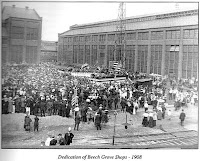
In 1904 construction began on a large repair facility by the Big Four Railroad (Cleveland, Cincinnati, Chicago and St.Louis Railway). Beech Grove as a town also had its beginning, at first only four homes and two businesses. But as the repair facility for engines and passenger cars grew, so did the town. Beech Grove was incorporated in 1906. The Shops were completed in 1908.. “Of the original 2400 acres the railroad had acquired, 640 acres were reserved for the Shops and rail operations, and the balance formed the original land for the town itself,” the authors wrote.
The name of the facility has changed over the years. In 1923 it took the name of its parent Company, the New York Central Shops. During World War II, it had its busiest years with 5000 men and women employed, but after the war railroad traffic declined, and in 1968 the NYC Railroad merged with Penn Central, and the facility became the Penn Central Shops.
The Federal Government created the Amtrak passenger rail system, which used the repair facilities of the Penn Central Shops in1975. In 1986 Amtrak took control of the facility, renaming it Amtrak Shops.
The attractive paperback, which sells for $23.50 at the Beech Grove Library also records the growth of Beech Grove, its businesses, schools, homes and celebrations. Beech Grove opted, in 1970, not to join UNIGOV, the county-wide consolidation with Indianapolis, and maintains its own government and municipal services. The Society has added a copy of the book to our collection of local histories, and you may look at it at our Meeting House.
Wednesday, April 13, 2011
Remembrances - Poetry

Brenda Lempp of Madison, Wisconsin, has been writing poetry, she says, since she was 13 year old. She was born and grew up in Acton, the third oldest of Clifford and Betty Kight’s nine children. Now married to her high school pen-pal from Germany, Steffan , who is a mathematics professor at UW-Madison, she is the mother of three children, and has recently published her second collection of poems about her childhood.
Brenda and I became acquainted several years ago when she worked for the Informer. After graduating from Franklin Central, she attended Franklin College, earning a degree in journalism. Brenda has worked for newspapers in Indiana, Florida, and Illinois. She has also taught, substituted, supervised a school lunch room, volunteered in school libraries, edited school yearbooks, and “clowned around as Buzzy the Clown with Happy’s Clown Club.”
Poetry has always been a big part of her life, she admits. She has led a poetry group for 20 years, and is a member of the Wisconsin Fellowship of Poets and the Wisconsin Regional Writers’ Association and. She published her first chapbook, Yellow Smiles, in 2000, and her poems have appeared in several publications.
Last year she produced her second book, Collecting Memories, Childhood Poems, dedicating it to her parents. So large a family provided Brenda with countless images and memories of the life they shared in Acton., images of home-made fun and happy times.
Brenda signed and sent two copies of her latest book, one for the Historical Society and one to me. In a note she said that she recently shared in a reading for the Wisconsin Festival of Poets. “I dedicated my reading to Mildred Mahler, and I read two of her poems,” Brenda wrote, “and several from my chapbook.” (Mrs. Mahler, named by some “Acton’s Poet Laureate” wrote many poems from which Olga Woolman and I chose some for a Township Historical Society’s publication, Apron Pocket Poems, printed in 1980.)
Collecting Memories contains 41 of Brenda’s poems, with the title poem on the back cover.
Being a poet, is a meaningful part of her life, Brenda Kight Lempp says, although she admits “I sometimes am too busy to write.” “But,” she adds, “I can’t stop writing.”
Brenda’s first chapbook, Yellow Smiles, Family Poems, about her three children, Kiki, Kari, and Kevin, was published in 2000. Her latest book, Collecting Memories was completed last year. Both books are in the Township Historical Society’s collection of local authors.
In Collecting Memories, Brenda writes about her own childhood in Acton where she grew up, one of nine children of Clifford and the late Betty Kight. She dedicated the book to her parents. Her poems reflect a happy, if sometimes crowded household, family fun, and many of the small-town pleasures of life in Acton.
The first one in the book is “Mom’s Favorites.”
I miss my childhood days(three holiday meals omitted)
when mom cooked peppery sausage, biscuits and gravy,
or hot French toast topped with grape jelly.
For a snack after school,
we loved hot buttered sugar and cinnamon toast,
Those cold Indiana winters were warm
with Mom’s special home-canned vegetable soup.
For dinner, cornbread crumbled with white navy beans
or garden green beans cooked with potatoes and ham.
And oh, I could never resist smothered liver
or a rhubarb crisp cooked in Mom’s old iron skillet.
When I get homesick, there’s nothing
like cooking Mom’s favorites,
Just the smell of a bacon and egg sandwich at breakfast
takes me back home.
There’s only room for the two final verses of “My Special Place.”
Sometimes I look back,/ and I see the little girl/sitting by the lamp.
I hear the refrigerator murmur,/ the clock tick on the wall.
I feel the thirst for knowledge/ and the flow of words on paper.
Years later,/ I still want that corner in my life.
There is my special place/ the lamp warmed me/ the bench hugged me
The clock listened to me, / the refrigerator soothed me,/And words flowed from my pen.
The next best thing to writing poetry is to read it. Thank you, Brenda.
Monday, May 10, 2010
Remembrances: Watercolor Cabin
Open Hours at the Society's Meeting House -- 6510 S. Franklin Road, from 1 to 4 p.m., on the first Saturdays, and the third Sundays of March through October -- are almost always an interesting time. All members are invited to share the afternoons, greet visitors, and perhaps help answer their questions.
We never know what a visitor may ask for -- information on his family -- the history of an old house he may be remodeling -- the photo of a great-grandparent who may have attended one of the district schools. We have a variety of places to look: abstracts, files of photographs, our own publications, scrapbooks and family histories. Sometimes we can help, sometimes not, but we never fail to try.
When township resident Stanley Wise came on our first Open Hours of the season, he said, "My father, Donald Wise, who died a few years ago, told me you had a picture of the old house -- a log cabin -- that once stood on Maze Road where the house my parents, Don and Iona Wise, later lived, and where I now live. The old house, my father thought, had a dug well in front, and another in the back, with a few outbuildings."
Several of us looked through our Area Old Houses book, our 2009 Calendar of historic homes, and through our collection of old photographs. Nothing. And then I heard Stanley say, "Yes, that's it." Dave Ostheimer had found what we were looking for -- but in a form that I, at least, had not thought of. It was a small framed watercolor, one of three given to the Society by Leroy Compton many years ago, on display in one of our cases.
The paintings were done by a relative of Leroy's, Dale Hendrickson, who with his wife liked to come "from the city" and visit his wife's sister, Leroy's grandmother, Edith Rabourn Maze at their farm home on Knapp Road. Dale sometimes brought his paints along. The other two watercolors are also country scenes -- a house on Knapp Road, and a log barn.
A card taped to the bottom edge of the frame identified the scene. "This log house was located where the Donald Wise family now live at 9540 Maze Road. Leroy Compton commented: 'My grandfather, Roy Maze, had a brother, Erasmus, who returned to Indiana from one of the Dakotas where the had homesteaded. Erasmus moved into the house where the Chamberlains now live, down a lane by the west side of the house in the picture. In the 1930s Erasmus built a new house on the site of the log house. My folks tell me that they remember the last occupant of the log house, an elderly single fellow who did odd jobs and lived from his garden, which occupied most of his summer time. My mother thinks the man's name was Nixon. Before the house was torn down, my grandfather stored farm implements in it.'"


