The Willard Library, a gorgeous piece of Gothic architecture, is the oldest public library building in Indiana. It's also rumored to be haunted -- and it seems someone caught the library's most famous ghost on camera. Click the link below if you want to see the pictures.
Showing posts with label historical sites. Show all posts
Showing posts with label historical sites. Show all posts
Wednesday, October 31, 2012
Indiana Ghost Story
Since it's Halloween, here's a story from Evansville, Indiana to give you seasonally-appropriate goosebumps.

Wednesday, September 19, 2012
Shelbyville Road Farm History, part II
Today, we bring you one of Sylvia Henricks' "Remembrances." You can read more of Sylvia's columns weekly in The Franklin Township Informer, or in her book From The Ash Grove (available directly from the FTHS, and via the web site).
 The hilltop farm home of Christian and Sophia Klasing on Shelbyville Road, which I wrote about in the September 5 “Remembrances,” is shown in another, later photo (at left), which appeared in the Township Historical Society’s publication The History of Franklin Township Area Old Houses (1982). By then, Christian and Sophia were deceased, the brick house abandoned, and the property sold. The new owners would develop the farm during the next several years into Franklin Parke Estates. The hilltop site now holds two houses, one of them the home of Scott and Mary Verbarg, who are interested in the history of their property.
The hilltop remains. That there was a wide view from the hilltop was never in dispute. But just how high was the elevation? Historical Society member Dana Crapo solved the question, by going downtown to the State Office Building and -- in spite of parking difficulties, and confusion in locating the right office -- buying a topographical map of the area which includes that part of Shelbyville Road where the Klasing farm lay. The map, 22” by 27”, printed by the U.S. Department of the Interior, is a U.S. Geological Survey, covers “the Beech Grove quadrangle.”(Topography, 1966; Roads, 1998.)
The map does record the height of the hill on which the farm house stood, slightly north of Shelbyville Road, at 900 feet. My six acres next door to the Franklin Parke Estates, are shown with two tiny black squares (one the garage) close to Shelbyville Road, east and somewhat south of the hilltop as 870 feet. I was surprised at this, as I always thought we lived “down in a hollow.” The Society Meeting House is 843 feet.
Indiana, A Guide to the Hoosier State, (1941) states on p.7 “About two thirds of Indiana is prevailingly level or rolling, while a smaller portion, largely in the south, is hilly. The average altitude is 700 feet above sea level. The greatest height, 1,285 feet is in Randolph County, near the eastern border; the lowest point, 313 feet, is in Vanderburgh County on the Ohio River.
(To be continued in a future "Remembrances.")
Wednesday, August 29, 2012
Shelbyville Road Farm History, part I
Today, we bring you one of Sylvia Henricks' "Remembrances." You can read more of Sylvia's columns weekly in The Franklin Township Informer, or in her book From The Ash Grove (available directly from the FTHS, and via the web site).

Now, 30 years later, all is changed. The farm has been gone for a long time, and the fields around it turned into Franklin Parke Estates, with its streets winding across the one-time fields. The hilltop remains, but is now the site of two handsome homes.
The new owner of one of the houses, Scott Verbarg, having seen my photograph of “The Klasing Farm,” asked me if the Township Historical Society had any information on what is now his property. I said I’d see what I could find.
I have been able to find a few items of interest. In the Society’s publication Historic Treasures of Franklin Township (1978 ) is a paragraph on page72 by an unsigned contributor, “Klasing History.” “Christian Klasing and his wife, Sophie (Kirkoff), came to the U.S. from Germany as children near the middle of the 1800’s.
“They were married in Indianapolis and in 1884 bought their 140 acre farm located at 7245 Shelbyville Road, presently owned by Mr. and Mrs. Allen Cary. The farm was purchased for approximately $8000 from Fred (Butch) Miller who had cleared all except forty acres of the land and built all the buildings that now stand on the farm.
“William Klasing (92) is the only living survivor of five boys and three girls in the Christian Klasing family. William owns seventy acres of the land which his mother and father bought, located at 7448 E. Southport Road.” Property lines and acreage can be seen in Section 13 on the 1889 Franklin Township map, one of the Society’s publications.
(To be continued in a future "Remembrances")
Thursday, March 15, 2012
Historic Indianapolis: Then And Now
It has been a trend for a few years to do time-lapse photo comparisons -- for example, look at a photo of your childhood home, and take a new picture from the same angle in present day to see what has changed. It's fascinating how places change over the years.
I found this article from Historic Indianapolis interesting, as well as sad. It illustrates how many once-prosperous Indianapolis neighborhoods have changed and declined over the years, and also how little we in modern days appreciate the beauty of spaces like this:
We've created a few then-and-now comparisons of Franklin Township properties, which have been on display in the Meeting House in the past, but we're always looking for more historic photos. If you have pictures or sketches of local property in bygone days, we'd love to see them!
Thursday, July 21, 2011
Members' Lunch at the Propylaeum
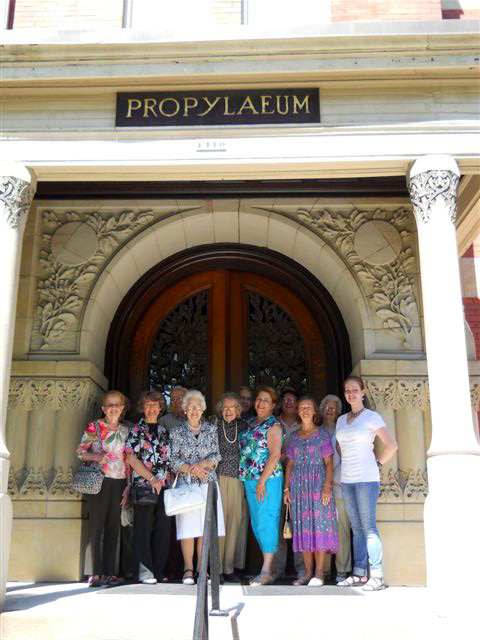
submitted by president emerita Sylvia Henricks
A day-trip is always fun, and the Society members who drove into Indianapolis in early July to visit the Propylaeum on Delaware Street for a tour and lunch had a good time. The big “Queen Anne style” mansion is the headquarters for a woman’s organization to “encourage the appreciation of the arts for the public, and especially for women." The name itself means “Gateway.”
It was organized in 1888, under the guidance of May Wright Sewell -- a painting of her by T.C. Steele is in the entrance hall – who became the first president. The group built an imposing stone clubhouse on North Street where they remained, sponsoring many groups for women, until the building of the World War Memorial in 1922 forced them to move. (Our member Joe Seiter brought a postcard of that first building to show us.)
The ladies purchased the house and lot at 1410 N. Delaware in 1923. The house had been built in the 1880s by a brewer whose wife wanted to live on the near north side, known as “the Gold Coast” area. It has many fine details – 12 foot ceilings, “pocket-doors.” A broad, carpeted staircase ascending three floors. A ballroom is on the third floor, along with the servants’ quarters. Six bedrooms and baths are on the second floor. Downstairs, the fireplace fronts are decorated with tile, believed to be Rookwood.
Later owners were George McCulloch, owner of the Indianapolis Star, and President and General Manager of the Indiana Transit Co. Another brewer, with many financial interests became the third owner, In the 1920s the College of Music and Fine Arts, a forerunner to the Jordan College of Fine Arts at Butler University, bought the property, but “decided to free itself from the financial burden, and the house was purchased with Liberty Bonds by the Propylaeum for $65,000. (Most of the above information is from a brochure given guests.)
As funds have allowed the house has been restored. It is a beautiful example of elegant living in a bygone era. We –14 of us—enjoyed a lovely meal in one of the formal parlors, the table set with stemmed glasses, china and
flowers.
 It was Evelyn’s birthday, and the hostess put her at the head of the table, with a tiara on her head. Our meals enjoyed and finished, our thank-you’s expressed to the hostess and the servers, we left through the “Georgian Style” front door with its hand-wrought iron grill, to return to our humbler, but no less treasured, Southside homes.
Friday, July 1, 2011
General Lew Wallace Study & Museum

A few days ago, I had the privilege of making a special tour of the General Lew Wallace Study & Museum in Crawfordsville, IN, an easy morning's drive west of Indianapolis. If you have not had a chance to learn about this great American hero and author, I encourage you to make the trip!
Lew Wallace fought in two American wars (most notably in the Civil War, where he successfully defended both Washington, D.C. and Cincinnati, OH from major Confederate attacks), served as governor of the New Mexico territory -- where he famously made a plea bargain with Billy the Kid, who later violated the agreement by breaking out of prison -- and served as the U.S. Ambassador to Turkey. He presided over the trial of the conspirators who assassinated President Abraham Lincoln. He was also an artist, a musician, an inventor and technological enthusiast. But he is best known as the author of the best-selling novel of the 19th century, a Biblical epic titled Ben-Hur. The book has been made into four motion pictures -- one of which is still tied for the record of most Academy Awards ever won by a single film -- an equally groundbreaking Broadway stage play, two stage musicals, and more.

The study, an exotic building of Wallace's own design and decorated with carved faces of characters from his books, is a delightful tour for those interested in history or architecture. It has been preserved in an almost undisturbed state -- it still contains Wallace's furniture, library and personal effects -- and is currently undergoing restoration on the interior to restore the original paint and intricate murals that were covered at some point in the past.
Also open is the visitor's center, originally the site's carriage house -- the gift shop is located in the stall belonging to the horse Wallace rode in the Civil War -- which houses an informative exhibit on historic preservation. For tour information, please visit the General Lew Wallace Study & Museum website.
Special Events
For Civil War enthusiasts, the museum is hosting a number of lectures and reenactments throughout the month of July, including lectures on the Underground Railroad, Civil War photographer Matthew Brady, and Mary Todd Lincoln. For more information, please visit http://ben-hur.com/aboutus/newsevents.html.
Subscribe to:
Posts (Atom)

